


Getting the best out of your onboard charger is vital if you want to get the most out of your electric vehicle. This is especially true if your vehicle is not equipped with a battery management system (BMS). A BMS will help you monitor the health of your battery and charge the batteries at the maximum speed possible. You will also know what to expect from your battery if it needs to be recharged.
Reducing the amount of energy your EV uses
Using an electric vehicle for commuting is no doubt a good idea. It can reduce your carbon footprint and eliminate noxious gases such as nitrogen oxide and carbon monoxide. But if you live in a temperate climate, you may find that your EV's range is limited. While cold weather may shorten your battery life, it is unlikely that this will cause long term damage. In fact, it could make you a happier EV owner.
Fortunately, the battery and charger manufacturers are working hard to improve battery efficiency and provide consumers with more choice in the coming years. It is also important to know that the EV battery is a relatively complex component. A typical EV has a liquid cooled power electronics system. This is accompanied by a battery that is made of lithium ion. Fortunately, these lithium ion batteries are capable of handling the rigors of a winter driving season. It is worth mentioning that in order to maximize your battery life, you may want to avoid driving your EV during inclement weather.
Summit Charger Series' Overheat Protection
When the internal temperature of the charger exceeds 80℃, the charging current will reduce automatically. When it exceeds 85℃, the charger shutdown for protection. When the temperature drop, the charger automatically resumes to charge.
Aside from putting your EV on the coldest night of the year, you may also want to consider recharging your EV during the day, especially if you're a commuter. Depending on the battery capacity of your EV, you may have to shell out about sixty kilowatt hours (kWh) to fully recharge your EV. The cost per kWh is also relatively low, compared to the cost of gas or diesel fuel. This is especially true if you opt for a lithium ion battery as opposed to a lead acid battery. If you want to reduce the cost of your electricity bill, consider switching to a low home, high work plan. The average cost of electricity in the United States is roughly $0.127 per kWh. This may seem like a lot to shell out, but if you take into account the cost of a gas fill up and the resulting carbon emissions, you could well be saving money by switching to an electric vehicle.
If you're looking for the best way to reduce the cost of your electricity bill, try switching to a low home, high work access plan. You may also want to consider switching to a renewable energy provider to offset your carbon footprint.
Battery management systems (BMS) monitor the status of the batteries
Using an onboard charger with high temperatures is not recommended. It can lead to fires and destruction. It can also increase the risk of short circuits. Battery management systems (BMS) offer protection against overdischarge and overcharging. They can be used to monitor the health of battery cells and perform recycling processes.
The battery management system (BMS) measures a number of battery parameters, including temperature, voltage, and current. It uses these data to calculate the SoC (Socially Compatible Charge) and SoH (Socially Compatible Health) of each cell. It also stores this information and makes short- and long-term predictions.
The most important indicator of battery health is the capacity fade. A capacity fade occurs when the coulomb count of the cells decreases as they are discharged. This can happen for several reasons, including inconsistent mechanical stress, internal resistance fluctuations, and different temperatures across the battery pack.
The battery management system measures this information, as well as the temperature of the coolant intake. It then calculates the relative differences between cells. The relative differences determine the amount of equalization that is necessary.
It also measures the voltage drop at a given load to identify the cell resistance. These measurements are necessary for the BMS to calculate the SoC.
BMS also uses a precharge system to make a safe connection between the battery and various loads. The precharge circuit may be comprised of power resistors, which are connected in series with the loads. These resistors improve the electrical conductivity of the battery when heated.
The BMS uses a number of communication lines to exchange data and power. It may include CAN bus communications, which are commonly used in automotive environments. It may also use general analogue sensors.
Battery cells are usually installed in series. The BMS will monitor the individual cells and balance the individual cells with the capacity. This is done through active balancing or passive balancing.
There are several BMS standards in place, including CAN bus communications, cell temperature measurement, and voltage monitoring of individual cells. It is important to choose a BMS that meets your needs.
Offboard chargers vs Onboard chargers
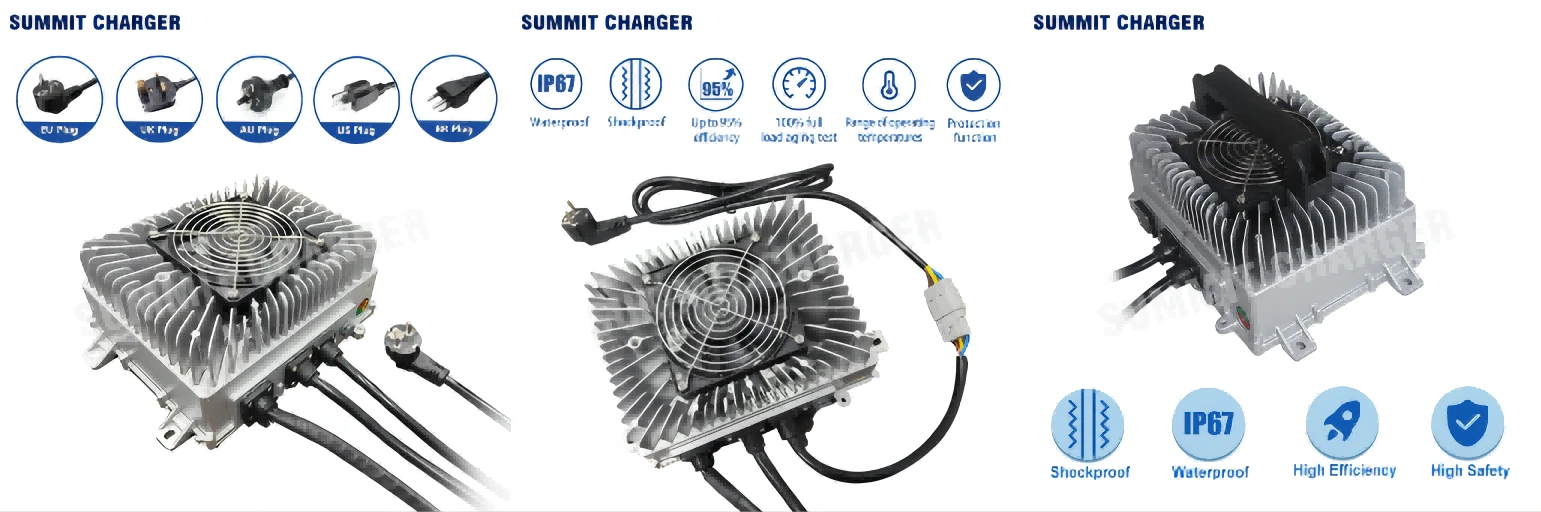
Despite the fact that onboard chargers are essentially designed to operate at full power in high temperatures, they still have many challenges to overcome. Thermal management and efficiency are the key factors in designing and building successful onboard chargers.
The wall of the enclosure must be a heat sink to dissipate heat generated by the electronics. The walls must also provide the required electrical insulation. The more efficient the onboard charger is, the less thermal energy it needs to dissipate.
Newer technologies have reduced the weight and size of onboard chargers. These include the use of SiC MOSFETs to reduce thermal energy dissipation and increase efficiency. This technology can also improve the efficiency of onboard chargers in confined spaces. The SiC MOSFETs are capable of supporting high frequency operations and run much cooler than Si superjunction MOSFETs.
The most efficient onboard charger topology is bidirectional. This allows EV batteries to discharge when the onboard charger is not needed, which can lower the SoC. Another option is to use a full-bridge converter. This reduces the cost of components while increasing the efficiency. However, it may also be more prone to switching losses.
The power output of onboard chargers ranges from 3.7 kW to 22 kW. However, there are some newer fully electric vehicles that have onboard chargers that range from 5kW to 6.6kW. The larger onboard chargers are also more expensive.
Some onboard chargers are designed with a J1772 5-pin connector. This 5-pin connector supports a wide range of alternating current charging rates. However, the charger must still be packaged inside a sealed enclosure. This ensures good thermal conduction and electrical insulation.
Newer charger designs also include bidirectional power conversion. These technologies also include a smaller enclosure and use silicon carbide (SiC) MOSFETs to reduce weight. The SiC MOSFETs run cooler than Si superjunction MOSFETs and therefore require smaller heat sinks.
The best way to engineer onboard chargers that operate at full power in high temperatures is to use SiC MOSFETs. This allows for smaller enclosures and requires less thermal management.
Summit Charger
