

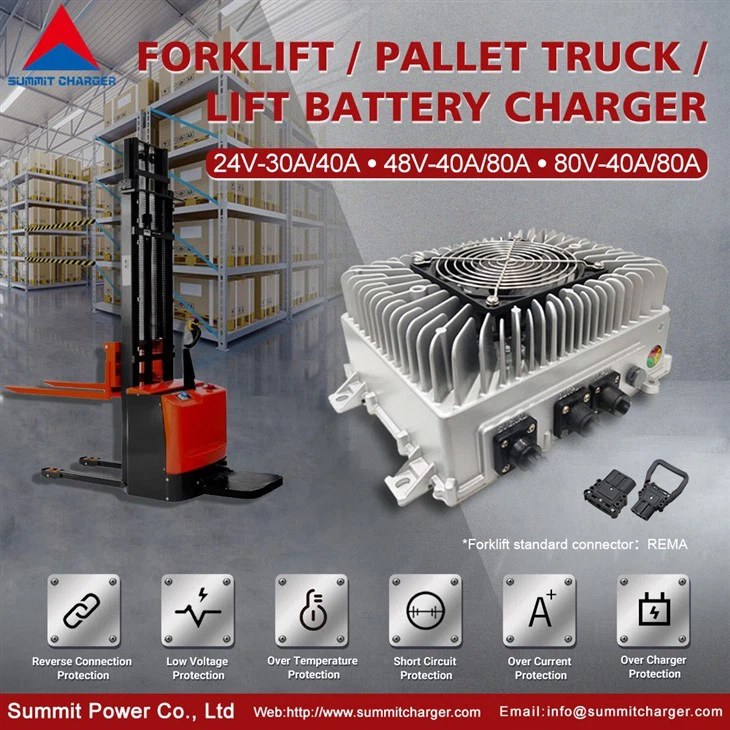




48V 80V Forklift Battery Charger
✱Input Voltage Range:AC90-264V,
✱Output Voltage:DC48V/60V/72V/80V/96V/120V/144V/170V/312V,
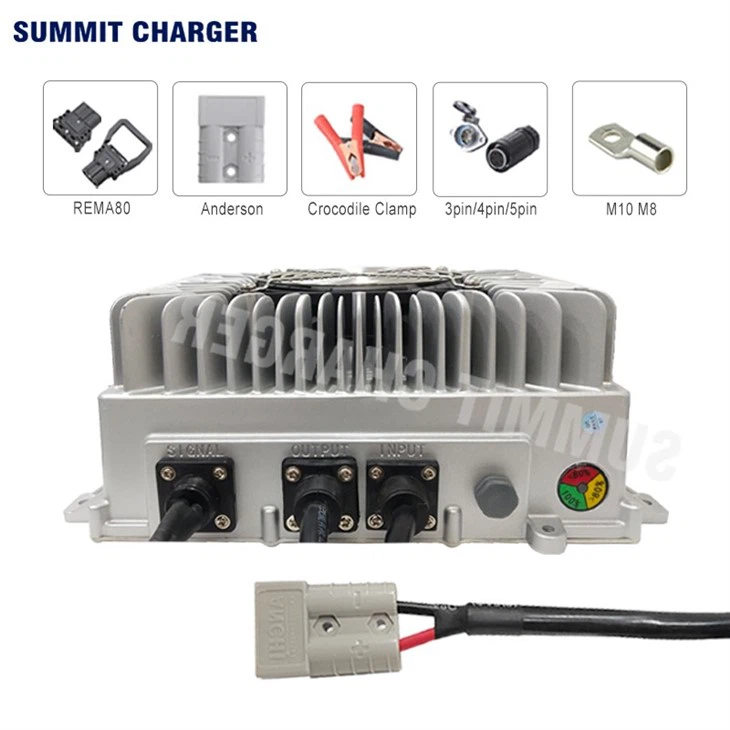
✱Input/Output Plug(optional),
✱Charging Indicator(optional),
✱CAN BUS or not(optional),
✱Size:294X210X111mm,
✱Net weight:5.9kg(13lb),
Send Inquiry
Product Details of48V 80V Forklift Battery Charger
Charger Datasheet
|
Model Number |
Input Voltage Range |
Rated Output Voltage |
Max Output Voltage |
Max Output Current |
|
SMHC3-4840A/4820C |
AC90~264V |
48V |
66V |
40A/20A |
|
SMHC3-6040A/6020C |
AC90~264V |
60V |
82.5V |
40A/20A |
|
SMHC3-7240A/7220C |
AC90~264V |
72V |
99V |
40A/20A |
|
SMHC3-8040A/8020C |
AC90~264V |
80V |
110V |
40A/20A |
|
SMHC3-9632A/9616C |
AC90~264V |
96V |
132V |
32A/16A |
|
SMHC3-12025A/12012C |
AC90~264V |
120V |
165V |
25A/12A |
|
SMHC3-14423A/14411C |
AC90~264V |
144V |
168V |
23A/11A |
|
SMHC3-17015A/17007C |
AC90~264V |
170V |
198V |
15A/7A |
|
SMHC3-31210A/31205C |
AC90~264V |
312V |
440V |
10A/5A |
Products Description

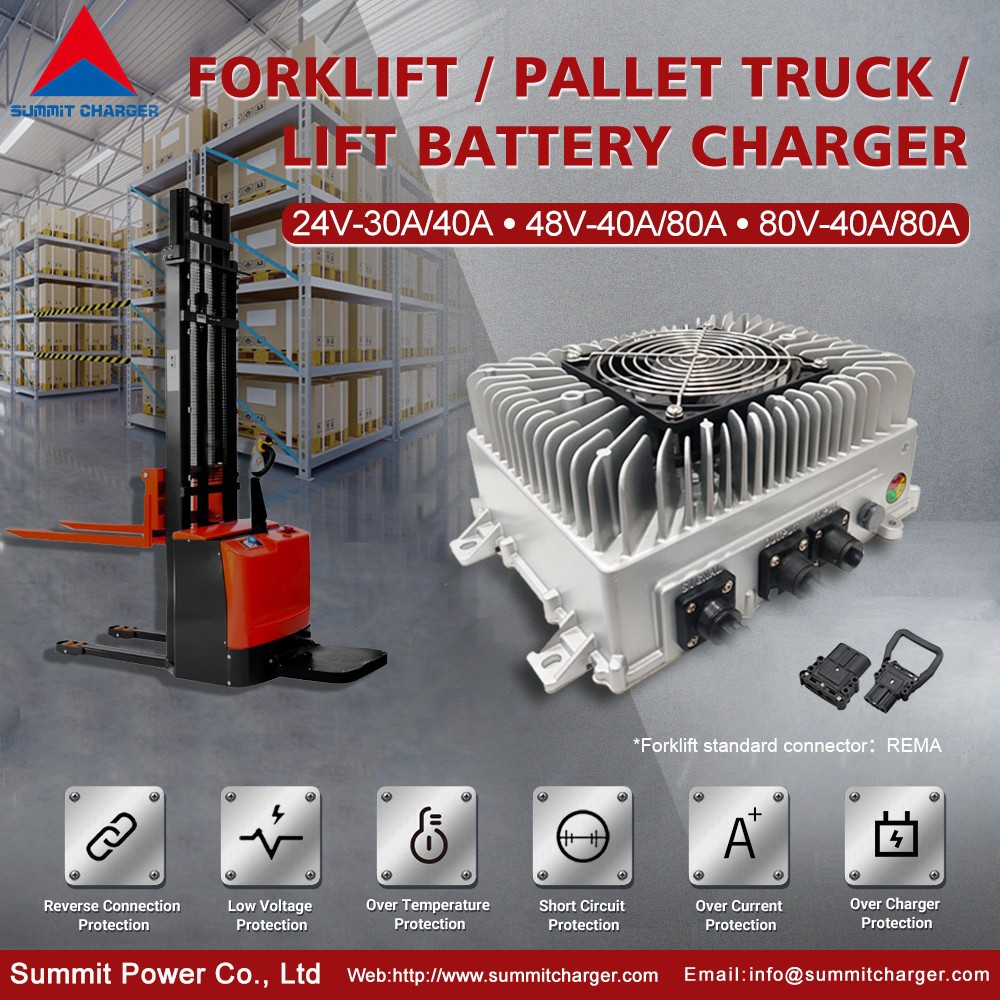
Introducing the SMHC3-3.3kW charger model, the fully-sealed battery charger that is built to last and protect. With multiple protection functions such as over temperature protection, over voltage protection, low voltage protection, short circuit protection, overload protection, and connection reverse protection, you can trust that your battery will be charged safely and efficiently.
This charger has a wide range of applications, making it perfect for high-speed motorcycles, e-rickshaws, forklifts, lifts, AGV, material handling equipment and more. It can also be CAN communication supportable or follow a certain charging profile that matches your battery parameters.
To help you capture your local markets, we offer customizable cords, housing colors, and dedicated labels. You can make your charger stand out with your own branding and style.
Unlike other chargers with plastic enclosures or thin aluminum alloy, the SMHC3-3.3kW charger series is made with thick and fully-sealed aluminum alloy, filled with silica gel, to gain waterproof, shockproof, and dustproof IP66/67 ratings. This ensures that your charger will withstand any harsh environment and last for years to come.
If you're looking for an upgraded charger that is reliable and durable, our SMHC3-3.3kW charger series is one of the best on the market.

48V 80V Forklift Battery Chargers
The right forklift battery charger can keep your electric lift truck running efficiently. It will monitor the battery temperature and adjust charging rate to prevent overcharging.
Lithium-Ion Batteries
Many operations are switching to lithium-ion batteries. These batteries provide more power to your electric forklift and last longer than traditional lead-acid battery technology. They also don't need to be cooled down between shifts. The process of charging a lithium battery is fast and simple. These chargers can handle voltage inputs of single-phase power. They can be plugged into a standard wall outlet. This allows for greater flexibility and can reduce downtime.
Conventional lead-acid batteries require overnight charging, which can damage the battery and shorten its life span. In contrast, lithium-ion batteries can be charged anytime during a work shift or break. This simplifies the process of charging and helps increase warehouse productivity.
When you use lithium-ion batteries in your forklifts, you'll save money on electricity costs, too. These batteries are more energy-efficient and last longer than traditional forklift batteries, which means you'll need fewer batteries overall. This will result in lower capital expenditures and maintenance costs, and you'll also avoid costly equipment investments in a battery room or hiring extra personnel to maintain the forklift battery fleet.
To get the most out of your lithium battery, it's important to properly charge it between shifts. This will ensure that the battery maintains its highest operating capacity and extends its lifetime. The best way to do this is by following the manufacturer's recommendations for opportunity charging. The process is easy, and only takes about 15 minutes to complete.
A good forklift battery charger will also monitor the state of the battery and alert you if it's going to lose its charge. It will also prevent overcharging and overheating. If you're not sure what the proper charger settings are, ask your forklift dealer.
Lithium batteries are a great choice for warehousing, but you need to make sure that your facility's electrical system can support them. Make sure that the charger is compatible with your facility's voltage, and that it has a data tag that indicates which phase it should be connected to. Then, separate the batteries by age and type to keep those that are near their end of life away from new ones.
Fast Chargers
Using fast chargers is an effective way to increase forklift battery life. It can reduce the time it takes to recharge a battery, which can save a lot of money in energy costs. In addition, it can also help in reducing maintenance costs. However, you should make sure that the charger is compatible with your forklift batteries. Otherwise, you may end up with damage to the battery and other forklift parts.
Lithium-ion forklift batteries can be charged in as little as 2 hours, which is significantly faster than a lead acid battery. They can even be charged during lunch breaks or while the forklift is idle. This is a great benefit for companies with multiple shift operations, and it can improve fleet availability. Moreover, this type of charger can help companies save on battery replacement cost, since it can be used for longer periods than traditional lead acid batteries.
A good forklift battery charger will monitor the state of the batteries and prevent overcharging. It will also provide a safety feature that will shut off the charger when there is a problem. In addition, it will monitor the temperature of the batteries and ensure that they are not overheated. These features will reduce the risk of fires and improve forklift performance.
The charger should be properly sized to the forklift battery's amp hour rating. Choosing one that is too large can cause overcharging and reduce battery life. On the other hand, going too small can cause undercharging and shorten battery life. A good charger will also stir the electrolyte and equalize the cells.
It is important to note that battery charging produces hydrogen gas, which can be dangerous if it leaks. It is important to keep the charging area clean and well ventilated. It should also be equipped with fire extinguishers and emergency showers to protect workers from injuries.
Chargers That Monitor Battery Temperature
If you use an electric forklift for long shifts, you will need a battery charger that monitors your batteries' temperature. This will help ensure that your forklift runs smoothly throughout the entire workshift and prevents battery degradation. A good charger should also allow you to change the charge rate according to your forklift's operating conditions. It should also support the same brand of forklift that you own. This will make it easier for you to get technical support when your batteries need replacing.
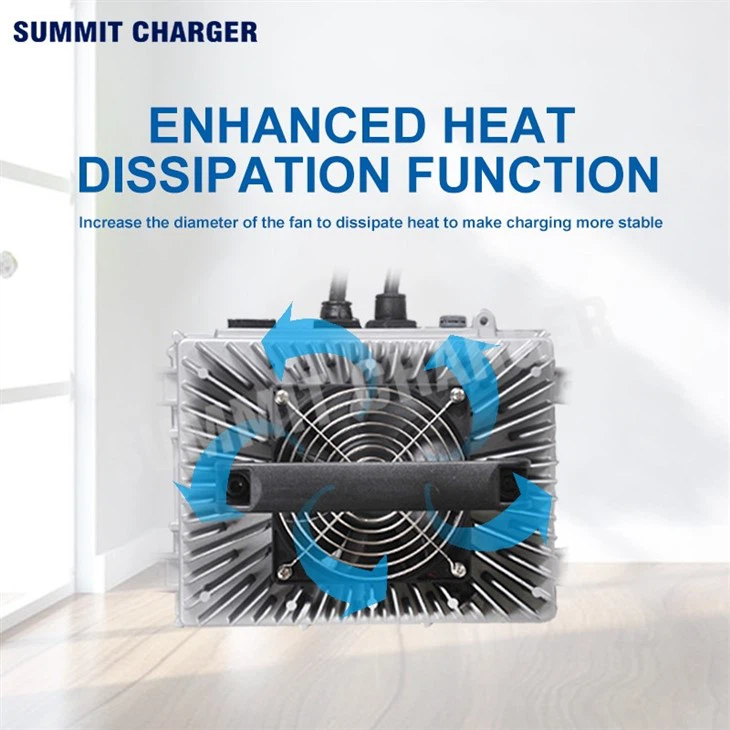
The best chargers are compatible with a variety of battery voltages and AH ratings. These chargers are flexible enough to match your facility’s power requirements, and they can adjust their charging rate to avoid overheating. You should always choose a charger with a cooling fan, which will reduce the heat generated by the charging process. It is also important to choose a charger that can detect the state of charge, and if it has a low voltage setting, it will automatically stop charging.
Most industrial batteries are “wet” batteries, which consist of two oppositely charged plates suspended in a mixture of sulfuric acid and water. Wet batteries require regular maintenance to keep them in optimum condition, including periodic watering and cleaning. However, wet batteries have a few drawbacks. They take a longer time to charge than other types, and their life span is limited.
Lithium forklift batteries, on the other hand, are more durable and can run for many hours without requiring recharging. Unlike lead batteries, they can be charged using a simple plug-in cord. In addition, they can be charged at higher temperatures than their lead counterparts.
To maximize your battery's lifespan, it is essential to charge it while it still has at least 20% of its capacity left. This will help avoid deep discharge, which can damage the battery and some forklift electrical components. A high-quality lithium forklift battery should last 15 years or more, if it is not subjected to deep discharge. In addition, lithium-ion batteries can be charged by a single charge cycle every day.
Chargers That Support Multi-Shift Operations
Forklift batteries have to be charged regularly in order to stay at a full charge. A battery that is not fully charged can become damaged and can also lead to overheating, which can be extremely dangerous. For this reason, a charger that supports multi-shift operations is essential. This type of charger will automatically adjust the charging rate depending on the battery state. In addition, the charger will monitor battery temperature and prevent overcharging.
When it comes to choosing a charger, you need to consider the type of forklift batteries that your business uses. There are several types of forklift batteries, including lithium, lead acid, and nickel-cadmium. These batteries have different lifespans and costs. You should also consider the voltage of your facility's power lines when choosing a charger. A charger with a voltage that matches your forklift's power line can help to maximize the battery's life.
A forklift battery charger with a voltage input that matches the voltage of your forklift's battery will ensure that your forklift is receiving a consistent charge.
The charger models we carry offer a range of output voltages (12 volt, 24 volt, 36 volt, 48 volt, and 80 volt).
Wet batteries require a specific charging station, which is a big drawback for businesses that operate on multiple shifts. They produce hydrogen gas during charging, and if the room where they're stored isn't ventilated properly, there is a risk of explosions. Lithium batteries, on the other hand, are sealed and don't generate hydrogen gas, so they can be used without any safety hazards.
Charger Details
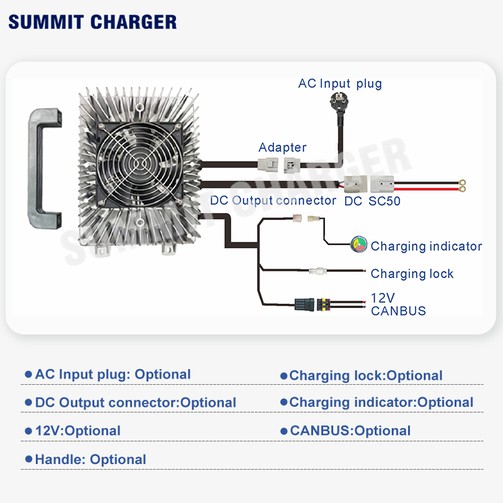
Optional Extended Functions
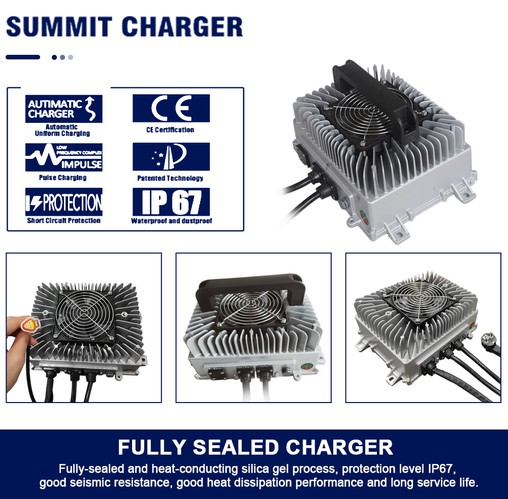
Charger Characteristics
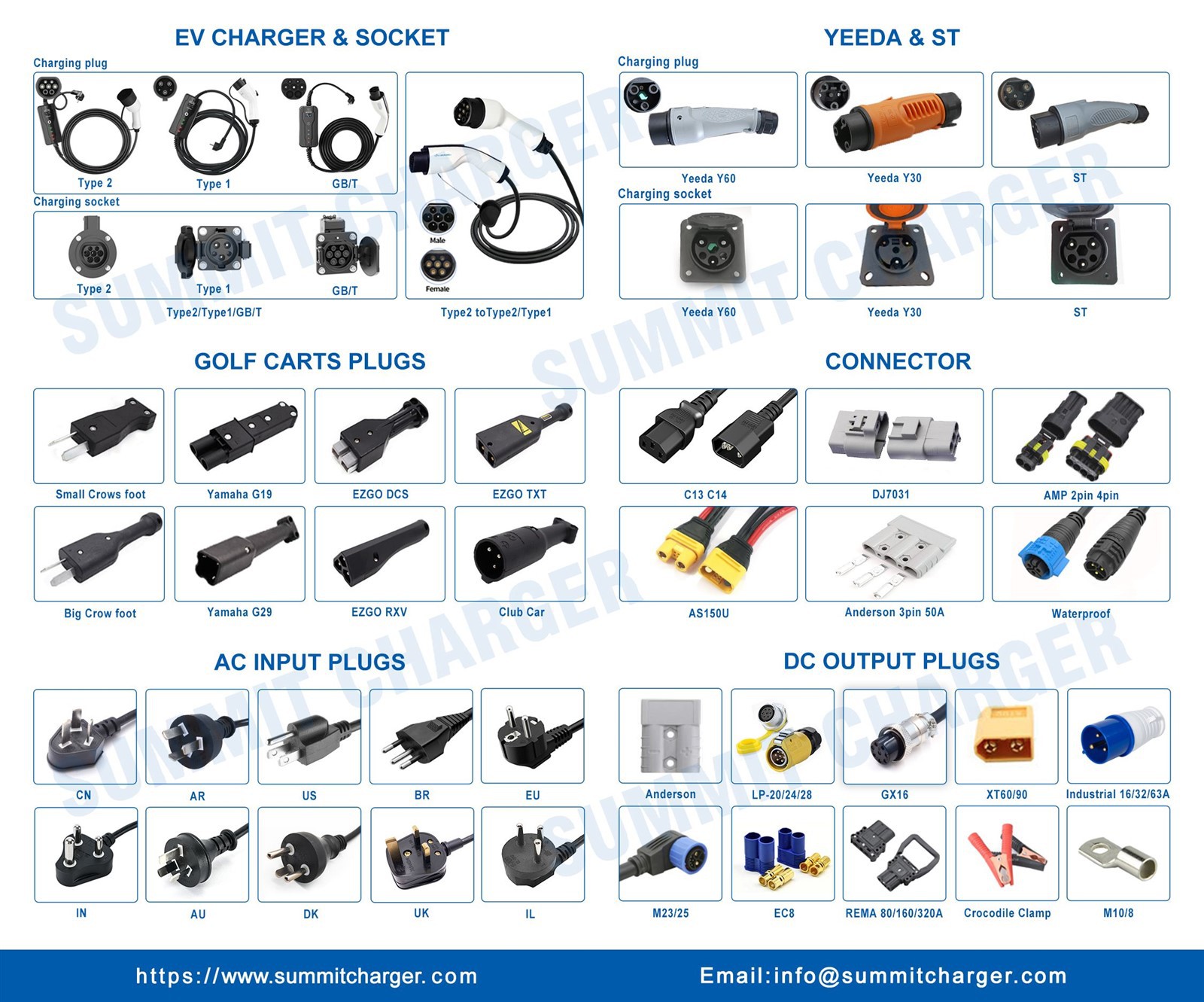
Charger Series

Our advantages

full services!
Selection recommendation
Quick Q&A
After-sales protection
Independent R&D Team!
Customization available
Technical Support
Charger development
 facebook
  linkedin
  youtube
  instagram
Hot Tags: 48v 80v forklift battery charger, China, suppliers, manufacturers, factory, wholesale, in stock
Previous
72V LifePO4 ChargerNext
ATV Battery ChargerSend Inquiry
